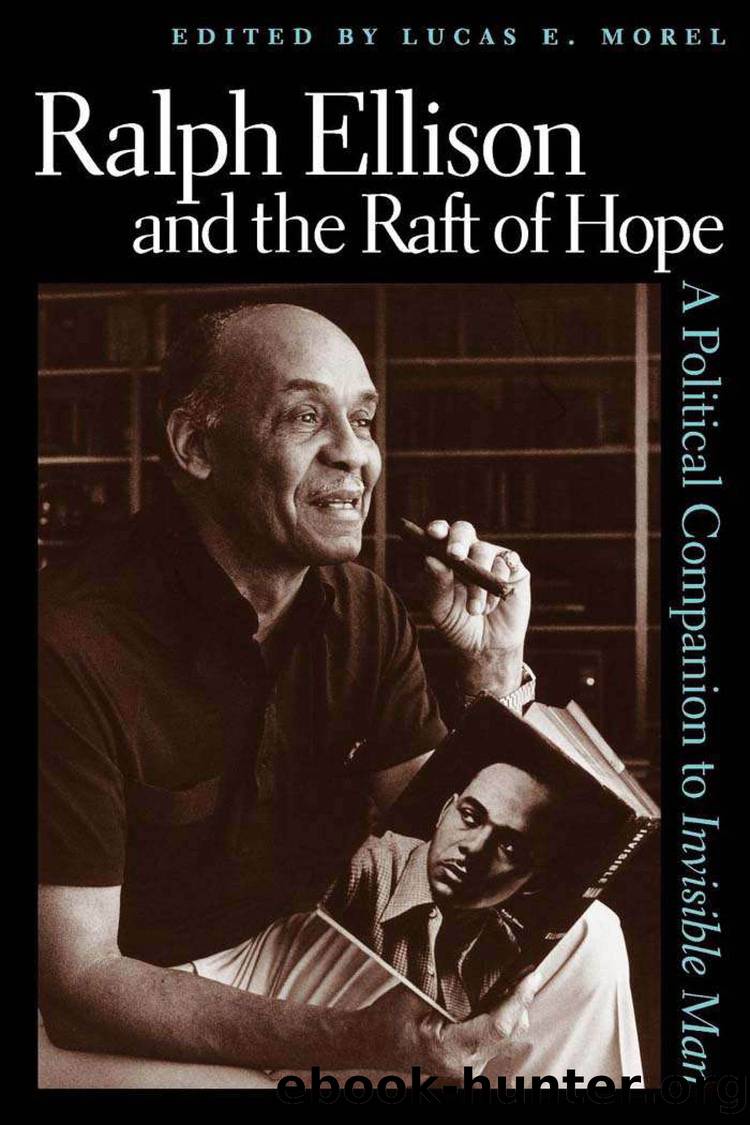
Ralph Ellison and the Raft of Hope by Lucas E. Morel
Author:Lucas E. Morel [Morel, Lucas E.]
Language: eng
Format: epub
ISBN: 9780813182643
Publisher: The University Press of Kentucky
Published: 2021-01-15T00:00:00+00:00
THE OKLAHOMA ORIGINS OF BROWN: OF ROSCOE DUNJEE, McLAURIN v. OKLAHOMA STATE REGENTS, AND . . . INVISIBLE MAN?
The Oklahoma of Ellisonâs youth was a place of struggle between competing visions of American race. Freed slaves and their descendants had come to the Oklahoma territory seeking a life less constrained by the norms of racial caste of more traditional Southern states. Yet white Southerners had also come to the territory and sought to replicate the society and the hierarchy they had known. The segregationists seemed to be winning the struggle. We see that in the persistent attempts by the Oklahoma legislature to prevent blacks from voting, to maintain unequal, segregated schools,11 in the Oklahoma courtsâ failure to abide by even rudimentary standards of due process (embodied in the Jess Hollins case), and in the lynching that took place while law enforcement officials looked the other wayâwhen they were not supervising it.12
But some blacks living in Oklahoma, like Roscoe Dunjee, had confidence that the rule of law (not the rule of police officers known as âlawsâ) would someday prevail. As Ralph Ellison reminds us in âPerspective of Literatureâ and in âRoscoe Dunjee and the American Language,â13 the Constitutionâparticularly through its equal protection clauseâcontains the seeds of justice. The idea is that the Constitutionâs covenant binds Americans to the dream that people should be treated equally. Dunjee expressed his confidence in the pages of his weekly paper, the Oklahoma City Black Dispatch. His editorials articulated an alternative worldview and an alternative view of the Fourteenth Amendmentâs âequal protectionâ clause. He argues that there should be uniform rules applied to all regardless of race.14 Thus, there should be equal voting rights (and registration requirements); equal funding for schools, even if the schools were separate; equal (even if separate) treatment on railroads; and no laws requiring segregation in housing.15
The Growing Meanings of Equality: The Protection of Personal Rights
Roscoe Dunjeeâs faith in the federal courts was sometimes fulfilled. Several important cases leading to Brown arose in Oklahoma. In the 1910s, the United States Supreme Court decided two cases from Oklahoma. The first, McCabe v. Atchison, Topeka, and Santa Fe Railway (1914), struck down Oklahomaâs railroad passenger segregation statute, which permitted railroads to provide luxury accommodations only to those groups who rode with sufficient frequency to make such accommodations economically feasible. In essence, the statute permitted railroads to provide luxury accommodations to whites only. The statute was challenged unsuccessfully in both the lower federal courts and the Oklahoma Supreme Court. But in the United States Supreme Court, Justice White rejected the proposition that economic considerations might dictate result. White looked to the effect of the statute on each person to whom it was applied, not to blacks as a group.
Whether or not particular facilities shall be provided may doubtless be conditioned upon there being a reasonable demand therefore, but, if facilities are provided, substantial equality of treatment of persons traveling under like conditions cannot be refused. It is the individual who is entitled to the equal
Download
This site does not store any files on its server. We only index and link to content provided by other sites. Please contact the content providers to delete copyright contents if any and email us, we'll remove relevant links or contents immediately.
| Anthropology | Archaeology |
| Philosophy | Politics & Government |
| Social Sciences | Sociology |
| Women's Studies |
Born to Run: by Christopher McDougall(7131)
The Leavers by Lisa Ko(6949)
iGen by Jean M. Twenge(5418)
Sapiens by Yuval Noah Harari(5374)
Spare by Prince Harry The Duke of Sussex(5200)
The Kite Runner by Khaled Hosseini(5185)
Machine Learning at Scale with H2O by Gregory Keys | David Whiting(4315)
Bullshit Jobs by David Graeber(4195)
Never by Ken Follett(3961)
Goodbye Paradise(3812)
Livewired by David Eagleman(3776)
Fairy Tale by Stephen King(3401)
A Dictionary of Sociology by Unknown(3086)
Harry Potter 4 - Harry Potter and The Goblet of Fire by J.K.Rowling(3076)
The Social Psychology of Inequality by Unknown(3037)
Will by Will Smith(2928)
The Club by A.L. Brooks(2927)
0041152001443424520 .pdf by Unknown(2849)
People of the Earth: An Introduction to World Prehistory by Dr. Brian Fagan & Nadia Durrani(2739)
